
1.1. Introduction
This section sets the definition of terms and terminology used in the documentation explaining the functioning of the entire ECCAIRS 2 (from now on it can be referred to as E2) through the perspective of different roles.
The E2 mission is to aid National and European transport entities in the collection, sharing and analysis of safety information in order to improve public transport safety. This section also briefly depicts what is E2, its goals and its legal support.
1.1.1. About ECCAIRS 2
ECCAIRS 2 (European Coordination Centre for Accident and Incident Reporting Systems) is the second version of an IT system designed to support a collaborative network of National Aviation Authorities (NAAs) and Safety Investigation Authorities (SIAs) from EU Member States, along with the European Union Aviation Safety Agency (EASA). Its core mission is to facilitate the collection, sharing, and analysis of safety-related information to enhance the safety of public transportation.
Key Objectives:
- Integration of original reports from disparate, currently incompatible sources.
- Providing an occurrence reporting solution for Member States without an automated system.
E2 implements collection and dissemination requirements for:
- Reports and Occurrences, as well as,
- Safety recommendations from the Safety Investigation Authorities,
Member States' safety data is consolidated in two central databases:
- ECR-ECCAIRS – The European Central Repository for Occurrences (required by Regulation (EU) 376/2014), which aggregates national and European-level reports.
- ECR-SRIS – The European Central Repository for Safety Recommendations (required by Regulation (EU) 996/2010).
System Architecture & Functionality
ECCAIRS 2 is an integrated system supported by two distinct but interconnected taxonomies:
- ECCAIRS Taxonomy (previously linked to ADREP) – Facilitates the collection and processing of original occurrence reports.
- SRIS Taxonomy – Enables the recording, tracking, and public dissemination of safety recommendations, including responses.
Occurrence Reporting Process
- Based on the ECCAIRS Taxonomy, which standardizes definitions and classifications.
- Reports are submitted via the E2 Web Application, validated, and converted into occurrences.
- Data can be shared at the European level (ECR) or optionally with other authorized entities within the E2 system.
There are three types of reports in the process:
-
- Original Report (OR): It is a description of the safety event submitted by a Reporter through the E2 Reporting Portal.
- Validated Report (VR): It is a copy of the OR validated by an Occurrence Officer through the E2 Web Application. It is editable, allowing enrichment. The Officer can also create a VR from scratch.
- Occurrence (OC): It is the main enriched report, representing the complete occurrence after integrating all related VRs. It consolidates all relevant information and can be shared with the European Central Repository (ECR) for further analysis and safety oversight. The Officer can also create and OC from scratch.
In broad terms the reports lifecycle includes receiving an OR, validating it into VR, integrating the VR into an OC, and finally sharing the Occurrences with the European Central Repository (ECR):


In some cases, managing an occurrence can be more complex, as a single event (such as an accident or incident) may generate multiple OR from different reporters. Each OR is validated into a VR, and all VRs are eventually merged into a single OC to be shared with the ECR or forwarded to another authority. Furthermore, if changes are made to an OR or VR after processing has begun, they may conflict with existing data—therefore, the process includes mechanisms to identify and resolve such conflicts:

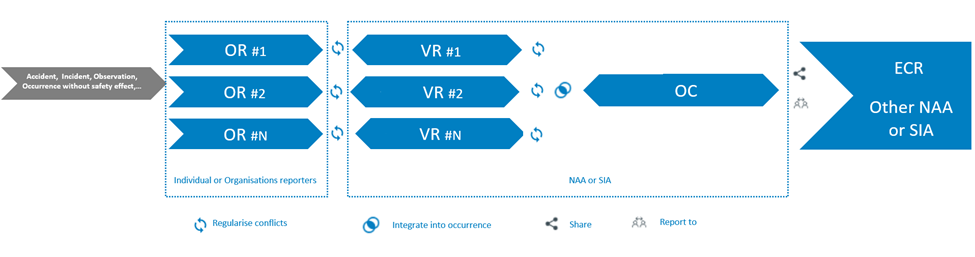
If an OR is sent to a non-competent authority, it may be transferred to the appropriate one.


The following picture shows the status workflow of the Original Reports, Validated Reports, Occurrences; and how they are related to each other.
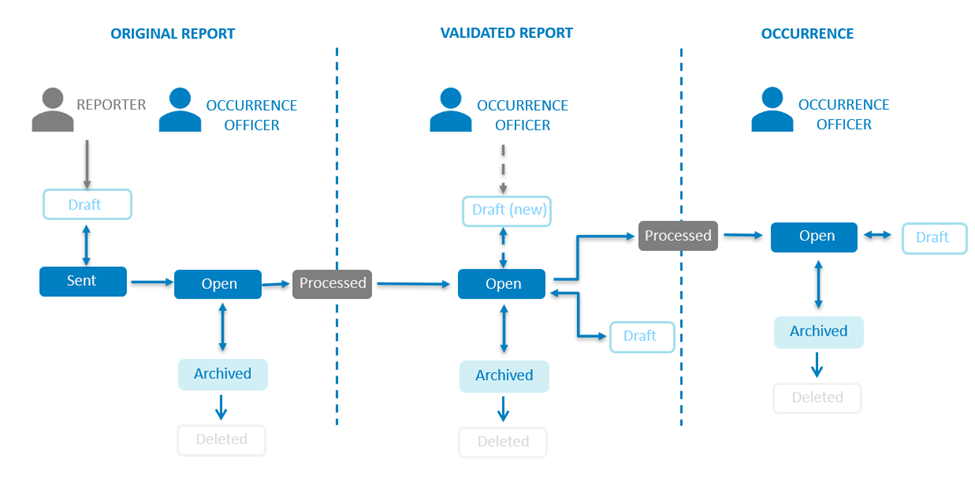
The roles involved are ‘Reporters’ and ‘Occurrence Officers’:
· Reporters, include individual and organisation Reporters, as well as those users that choose to report an Occurrence without registration.
· Occurrence Officers, include all the users that are part of an Authority, and have permissions to view, create and edit documents.
Safety Recommendations Process
- Powered by the SRIS Taxonomy to support Safety Investigation Authorities (SIAs).
- Enables the recording, tracking, and publication of safety recommendations, along with response monitoring, on a dedicated public portal.
The system process:
-
- Safety Recommendation (SR): It is the proposal of a Safety Investigation Authority based on information derived from an investigation made with the intention of preventing accidents or incidents and which in no case has the purpose of creating a presumption of blame or liability for an Occurrence. In addition to Safety Recommendations arising from Occurrence investigations, Safety Recommendations may result from diverse sources, including safety studies.
The following picture describes the lifecycle of the SR’s life from its creation to its publication, or archive and deletion.
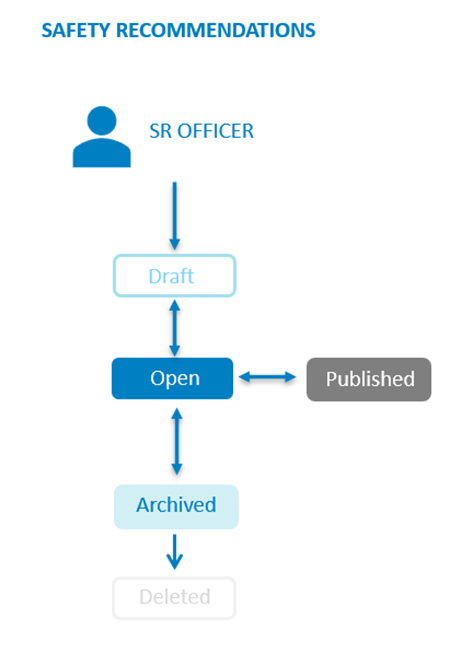
SR Officers, include all the users that are part of the accident investigation Authority, and have permissions to view, create and edit Safety Recommendations.
Original Reports, Validated Reports, Occurrences and Safety Recommendations Records exist in two type of versions: major versions that are shared and minor versions that only available for the Authority. There are also draft versions that are visible to the user only.
1.1.2. ERCS
Regulation (EU) 376/2014 on Occurrence Reporting, requires that member states risk classify all Occurrences using the European Risk Classification Scheme (ERCS). The ECCAIRS2goal Taxonomyof this risk classification is to enable a standardizedharmonised classification system that defines the structure and encodingassessment of data fields in aviation occurrence reports. It serves as the official reference for ECCAIRS2, ensuring uniformity in occurrence reporting and coding. By providing a clear framework for data collection, the taxonomy enhances interoperability, supports safety analysis,risks across Europe and promotes regulatory compliance. Publicly available, it enables consistent and reliable reporting across the aviationdifferent industry.technical domains, such as commercial air transport operations, leisure flying, ATM/ANS, or aerodromes and ground handling.
The followingEuropean sectionsRisk describeClassification allService the(ERCS) functionalities and tasks that Occurrence Officers can perform using the E2 Web Application. They can only access information—such as reports, queries, and views—thatwizard is owneda bytool theirto respectivehelp Authority.
Occurrence Officers can find essential informationfill in the followinginformation. sections:It is based on what is captured in the Support Master Tables. Each table defines the restrictions and dependencies between the Value List values of the Attributes involved in the ERCS calculation.
There Safetyexist 3 Support Master Tables:
· ERCS KRALevel1/Severity
· ERCS Barriers
· ERCS Matrix
1.1.3 Taxonomy
Background:
The E2 portal collects information on incidents concerning civil aviation. This information comes from people from different origin, technical and not technical. Bringing together data that has used different definitions makes it very difficult to analyse and draw meaningful conclusions. That is why a specific classification to unify the terms concerning the aviation reporting was needed and introduced in the portal. First a group of forward-thinking people got together at global level under the guidance of ICAO to develop a common aviation Taxonomy. This was called the Accident/ Incident Data –Reporting outlinesSystem all(or toolsADREP). After some time, the management of this Taxonomy at a detailed level has passed to EASA forming the basis of the ECCAIRS system. Today, it is known as the ECCAIRS Taxonomy and it is a vital building block for managingsharing reports.data Dataat ManagementEuropean – includes Queries to filterLevel and export reports (OR, VR, OC), plus Word Templates.
Taxonomy Browser – helps locate entities and attributes with clear definitions.
Other Features – offer additional support for workflow tasks.